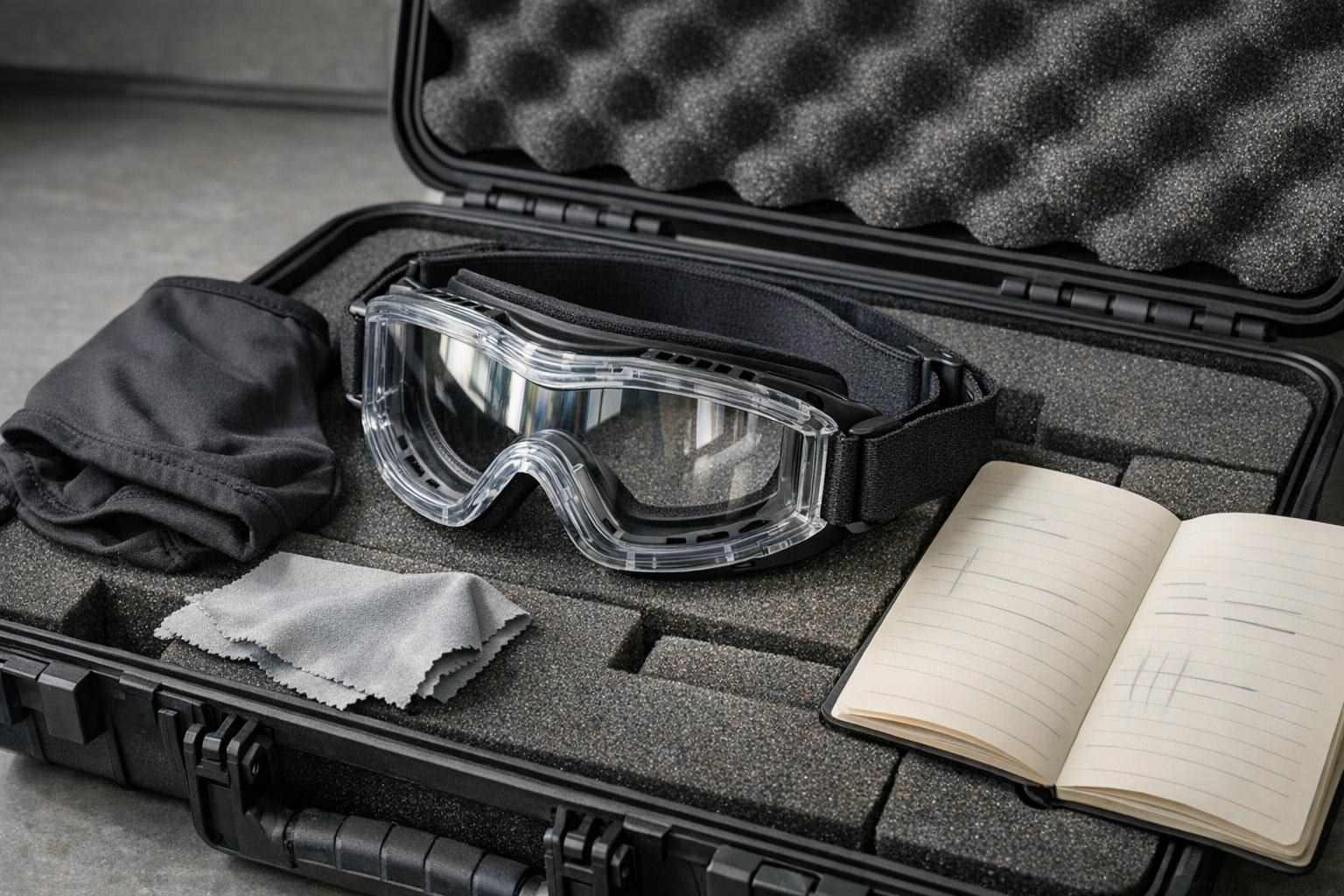
You need new eye protection for your next game of Airsoft. Two reviews seem to recommend the same product, but one of them is packed with close-up pictures and sounds very convincing, while the other review explains how he used it for testing, what he checked and where it failed. A convincing page does not necessarily mean a good tested product. You have to be able to distinguish between your observations and the marketing messages and learn to spend your money wisely and to fulfill all the requirements of the fields you play on. The airsoft gear you buy has to fit your kind of playing.
Start with the decision, not the star rating
Prioritize your decision criteria. For this problem, that would be eye protection that is compatible with a face mask that the player can wear for long periods of time, and which complies with the rules of the field at which the player intends to play. See the above diagram for a way of organizing such a prioritization process.
For instance you could write down the following features that could change your purchase decision: fit, field of vision, ventilation, cleaning, compatibility with other equipment, durability and the return policy of the vendor. You might find one review that is very detailed about the appearance of the item, but this does not necessarily mean that it is a good review for your specific needs.
It is also important to remember that star ratings are only a starting point. A product with a high score could be perfect in many ways, but also unsuitable because of incompatibility with other products. A product with a low score could have one major weakness, but otherwise be perfect for your needs. Read the review thoroughly to ensure that you understand why a product received a certain score.
Look for a method you can actually evaluate
Although the test of an airsoft replica, parts or accessories does not have to be done in a laboratory, it is necessary to describe in detail what has happened. This means that in addition to describing the product that has been used in the test (the product configuration), it is also necessary to describe the conditions under which the test took place (the use to which the product was put), how long the test lasted and what checks were carried out after the test.
Specific limits are useful. This means a review that states it only tested for fit and comfort is far more useful than a review that makes broad claims regarding durability after a short test where the item was only handled. Replicas, loaders, clothing, batteries and even maintenance chemicals for cleaning all can be tested for short term handling and use, for installation and for longer term use.
A great test report will include a description of how the test was conducted, what has been measured or compared. Be wary of terms such as 'field proven', 'best performance' or 'built to last'. These can often be nothing more than marketing flimflam and you should look for a description of what has been actually tested.
Separate visible observations from persuasive language
Most reviews contain a number of different types of statement. There are those that report observations of close detail (the strap is adjustable in the various directions in this photo for example). Then there are interpretations and opinions of what has been observed (this design looks to be suited for wet conditions for example, or this will be ideal for occasional players who want good equipment etc). And finally there are the straight copies of advertising blurb.
Make sure you can tell the difference between the review being written by someone who is testing out a feature for you and someone who is simply repeating packaging copy. Even if the reviewer hasn't verified the information with the manufacturer, it's often included in the specs, so that's useful to you as a reader.
Photographs of replicas, loadsters, face protection, masks, clothes, sights and other equipment are also insufficient to be able to determine the long term durability of airsoft replicas, airsoft guns, airsoft rifles and other related products. Nor can photographs prove the safety of these airsoft products or their compliance with the rules of a particular airsoft field.
Treat disclosure as useful context, not a verdict
The advertising disclosure in the review will tell you about any relationship that the writer of the review has with the product or the company that makes the product. This can include products that have been supplied to the writer for review, sites where the writer earns affiliate commission for products that he or she recommends, and sites where the writer is paid to write review articles for specific companies.
This does not mean that any supplied product is automatically a bad review. Lots of independent editorial work is done with supplied products and the commercial page can still contain loads of useful information and even a few (plaintext) positive comments, as long as the disclosure is clear.
These things to look for in order to assess whether the editor is independent enough (clear limitations, specific negatives, a clear separation between advertising and review, a recommendation based on a specific user profile). Also, note whether the reviewer clearly states who should not buy this item – that is a very good review!
Cross-check the claims that could affect your safety
When a reviewer reviews protective equipment for example airsoft masks, goggles and face protectors look for the relevant safety markings, the instructions for use, the safety requirements for the field for which the product was designed and see if the manufacturer is currently fulfilling these requirements. Also be aware that safety requirements can change over time so don't rely solely on a review for your safety.
Also note that even for components that you will use only for the airsoft game (such as a battery for a remote control) that are reviewed for normal use, you need to verify whether the same component was used for the test and also the same method of use.
For general performance claims, a comparison of reviews is best done by looking for reviews from people with different motivations and uses for the same item. One account of an awkward to adjust piece of equipment or of a product that is difficult to clean up after is worth more than a whole collection of reviews which failed to measure up in these respects.
Turn the review into a purchase decision
Go back to the player, preparing for the big weekend game. Use the review to improve your shopping list and your questions when buying online. A review may look good at first but in the end there may be many unknowns, like in the case of the straps of this backpack. The straps look good but are they compatible with the player's face covering?
A simple three-part note such as confirmed, reported and unresolved helps one to process information given in airsoft reviews better. The term 'confirmed' is used to denote instances where the reviewer refers to information given in the manufacturer's instructions or the information given in a review that was clearly described. The term 'reported' is used when the reviewer simply relates their experience with airsoft. The term 'unresolved' is used when airsoft equipment's durability, fit or performance is not tested by the reviewer.
Good coverage of airsoft equipment is useful in helping to verify claims. It does not however, mean you have to be a fool. Use the information provided in airsoft reviews to make informed purchasing decisions and choose the correct piece of equipment for your intended use. Use the piece of equipment as instructed and comply with the current rules of play for your field.